On this page:

Our 60-30-10 rule for branding and design uses primary colors (60 percent), secondary colors (30 percent) and tertiary colors (10 percent) to create a balance within the visual space. If tertiary colors are omitted, apply a 60-40-0 rule.

Consider your project's needs:

  • For Digital: Use HEX or RGB
  • For Print: Use CMYK (preferred) or Pantone

What’s the Difference?

  • HEX colors are used primarily to specify colors for web pages.
  • RGB is an additive color model using red, green and blue light sources.
  • CMYK mixes four standard inks cyan, magenta, yellow and black to create colors.
  • Pantone uses a system of pre-mixed, specific spot inks.

Primary Colors

The three primary colors used in the Stony Brook Medicine brand are SBM Red, SBM Black and SBM White.

Choose a color format

Note: Use RGB (Red, Blue, Green) for digital images, videos, and anything meant to appear on screens.

SBM Red 100%

RGB: 153 / 0 / 0

Use at 100%, do not tint.

SBM Black 100%

RGB: 0 / 0 / 0

SBM White 100%

RGB: 255 / 255 / 255

Use at 100%, do not tint.

Secondary Colors

Secondary colors should be 30 percent of the space. If tertiary colors are omitted, apply a 60-40-0 rule. Secondary colors add contrast and depth to achieve a more impactful design.

Choose a color format

Note: Use RGB (Red, Blue, Green) for digital images, videos, and anything meant to appear on screens.

SBM Bright Red 100%

RGB: 213 / 32 / 39

Use at 100%, do not tint.

SBM Dark Red 100%

RGB: 107 / 0 / 13

Use at 100%, do not tint.

SBM Light Gray 100%

RGB: 190 / 190 / 190

SBM Medium Gray 100%

RGB: 130 / 130 / 130

SBM Dark Gray 100%

RGB: 75 / 75 / 75

SBM Royal Blue 100%

RGB: 0 / 84 / 154

SBM Peacock Blue 100%

RGB: 10 / 128 / 164

SBM Teal 100%

RGB: 57 / 191 / 201

Tertiary Colors

Tertiary brand colors create depth and versatility but should be used sparingly.

Choose a color format

Note: Use RGB (Red, Blue, Green) for digital images, videos, and anything meant to appear on screens.

PANTONE 584C 100%

RGB: 214 / 219 / 62

PANTONE 7625C 100%

RGB: 237 / 79 / 48

PANTONE 603C 100%

RGB: 239 / 222 / 86


Graphic Elements

A visual approach to all Stony Brook Medicine marketing materials is called “Branded Gradient”. Two approved color approaches have been created for Stony Brook Children’s branded marketing content.

When should I use the SBM Teal / Peacock Blue Gradient?

SBM Teal
SBM Peacock Blue

Our primary color hierarchy must be visible. The 60-30-10 rule for branding and design uses our primary colors at 60 percent (SBM Red, SBM Black and SBM White combined), secondary colors (30 percent) and tertiary colors (10 percent) to create a balance within the visual space. If tertiary colors are omitted, apply a 60-40-0 rule.

When should I use the SBM Red Gradient?

SBM Bright Red
SBM Red
SBM Dark Red

When 60% of SBM Red, SBM Black and SBM White combined are not enough to support the 60-30-10 rule within the branded marketing piece.

The “branded gradient” can be applied using both color options.
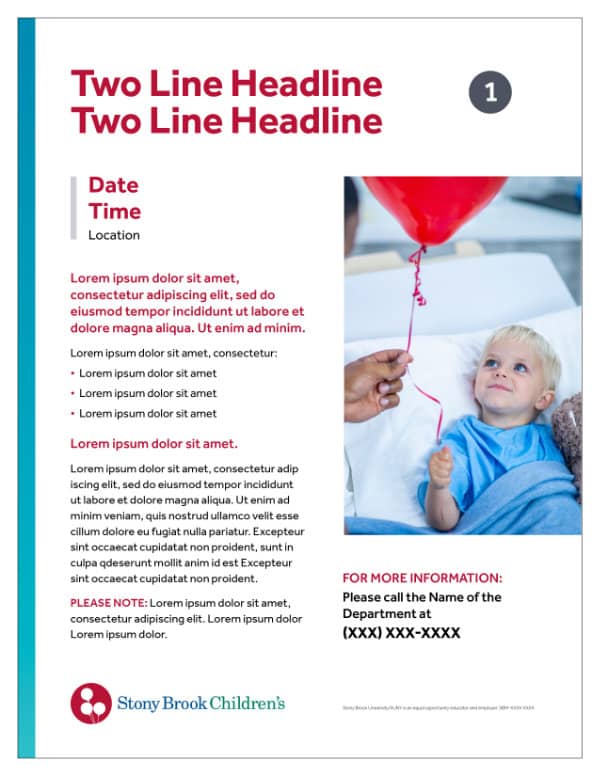
Left Vertical SBM Teal /SBM Peacock Blue Gradient Example
Top Horizontal Thin SBM Teal /SBM Peacock Blue Gradient Example
Left Vertical SBM Red Gradient Example
Top Horizontal Deep SBM Red Gradient Example

Examples shown: Flyer 8.5" w × 11" h; non-bleed; gutter 0.25"; holding rule .5 point, SBM Black
  • Option 1, Left Vertical SBM Teal /SBM Peacock Blue or Red Gradient:
    • SBM Red Gradient is 0.25" w to 10.5" h; shows top/bottom dark to bright.
    • Margins: top and left 1.0"; right 0.75"; bottom 0.875".
  • Option 2, Top Horizontal Thin SBM Teal / SBM Peacock Blue or Red Gradient:
    • SBM Red Gradient is 8.0" w × 0.375" h shows left/right bright to dark.
    • Margins: top 1.1875"; left 1.0"; right 0.75"; bottom 0.875".

Headlines

  • 1 and 2: Effra Bold; SBM Dark Gray; Optical 0 kerning. Example shows 40 point/38, flush left.
  • 3: Effra Bold, SBM White, Optical 0 kerning. Example shows 40 point/40, flush left.
  • Hard return plus 0.3125 leading to first sub headline position or top flush with right column imagery when possible.

Call Out Text

  • Effra Bold, SBM Red, Optical 0 kerning; 24 point/27, flush left.
  • Text location can be relocated above logo or in the right column under imagery.

Subheads

  • Effra Medium, SBM Black or SBM Red, Optical 0 kerning; 14 point/17, flush Left.
  • Primary Font Alternate Option: Museo Slab 700.

Body Copy

  • Effra Regular, SBM Black, Optical 0 kerning; 12 point/16, flush left, additional leading 0.0625 between paragraphs.

Bullets with Body Copy

  • Bullets: SBM Red, Tab 0.125”; Effra Regular.
  • Text: Effra Regular; SBM Black; Optical 0 kerning; 12 point/16, flush Left; additional leading 0.0625 between bulleted lists.

EOE Statement and Job Number

  • Effra Light, SBM Black, Optical 0 kerning, 5 point/7. Placement is optional.

Logo Placement

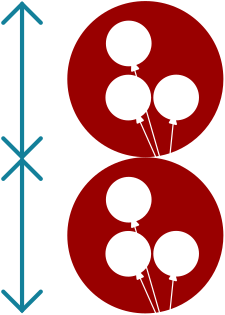
  • The ideal minimum space below the outer edge of the logo is equal to the height of the balloon icon of that logo. Otherwise, the width of the B in Brook is absolute minimum space.
Balloon Height Reference

Gradient Accents

Apply color gradients as a graphic accent. The SBM Teal / Peacock Blue and Red Gradient are the main gradients used on most branded marketing content to reinforce our primary brand color. Use secondary color gradients minimally to add contrast, within illustrations and graphic shapes.


SBM Red Gradient

SBM Bright Red
SBM Red
SBM Dark Red

SBM Teal, SBM Peacock Blue Gradient

SBM Teal
SBM Peacock Blue

SBM Teal, SBM Peacock Blue, SBM Royal Blue Gradient

SBM Teal
SBM Peacock Blue
SBM Royal Blue

SBM Teal Gradient

SBM White
SBM Teal

SBM Peacock Blue Gradient

SBM White
SBM Peacock Blue

SBM Royal Blue Gradient

SBM White
SBM Royal Blue

How to Use

  • SBM gradients are created by combining two or three colors from either a HEX, RGB, CMYK or PMS color palette.
  • Do not combine color palettes, such as HEX with CMYK colors.
  • Only use the approved SBM gradients shown here.
  • SBM gradients are always linear; never radial.
    • Set gradient ramp to 0-100 for two colors.
    • Set gradient ramp to 0-50-100 for three colors.